Why Do Spanish Nouns Have Gender
The real question should be why English doesnt have that anymore. Nouns sustantivos describe people places things and concrete or abstracts conceptsIn Spanish grammar nouns are classified by gender as masculine or feminine.
Spanish Adjective And Noun Worksheet Nouns Worksheet Spanish Adjectives Nouns And Adjectives
This is a question of their origins and evolution.

Why do spanish nouns have gender. But do nouns have a gender in English. Updated September 21 2018. Gender is just one version of noun class systems.
Although a philologist can probably tell you the story better. Thats why all Spanish nouns are either masculine or feminine. With only a few exceptions mostly those of occupations such as dentista the gender of nouns doesnt change with the context and a nouns gender determines the form of many adjectives that describe it.
Do nouns change gender in Spanish. Just as maleness or femaleness is an inherent characteristic of most animals so is gender an inherent characteristic of nouns in Spanish. Interested in learning Spanish.
The fact that inanimate objects have a gender in Spanish does not mean that things like tables and books are physically feminine or masculine. Why do Spanish nouns have gender. Answer 1 of 14.
This is a question that virtually no Spanish speaker you talk to will be able to answer. GENDER IN FRENCH NOUNS 3 ish-speaker will be able to predict the gender of approximately 70 of French nouns. There were three genres in Latin.
The idea that nouns have gender seems perfectly natural when the noun stands for a living creature. Because many nouns end in letters other than o or a. In Romance languages and many others nouns have a gender.
Spanish children learn gender of nouns because it would be wrong to say el aguo and they learn what their parents say who in turn learned what their parents said an so on back to Latin and before. Learn the rules for identifying masculine and feminine nouns in Spanish grammar with Lingolia. As it happens this is the umpteenth iteration of this question.
Masculine feminine and neuter. Masculine feminine and neuter. This is because in English living creatures often have different names depending upon whether they are male or female.
The question I originally answered was worded as. Spanish is a Romance language derived from Latin through Vulgar Latin which had the gender distinction for all nouns. Because the definite article el la is your clue as to whether a noun is masculine or feminine.
This is because in English living creatures often have different names depending upon whether they are male or female. Turns out they used to. Because not every noun that ends in -o is masculine and not every noun that ends in -a is feminine.
And thus the gender distinction rule persists in Spanish. In Spanish all nouns are either masculine or feminine. I believe it helps in rearranging the order of sentences and constructing complex sentences without confusion.
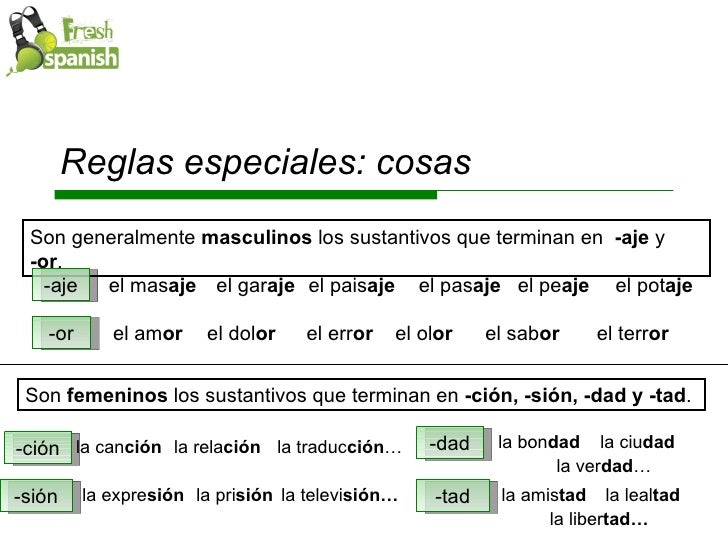
The gender of the noun is important because the adjective and articles must also be masculine. Because you cannot predict the gender of most nouns. The gender of a noun in Spanish can generally be identified by the noun ending however there are some exceptions.
The idea that nouns have gender seems perfectly natural when the noun stands for a living creature. They have genders in a grammatical sense and must be used with articles and adjectives that match their gender. Gender in Spanish language.
Why does French among other languages still use masculine and feminine nouns despite the fact that this seems entirely pointless and irrational. In Spanish all nouns are either masculine or feminine. Although the same example words I just listed in English would be the same gender in Latin and are the same gender in Spanish there were other words that were neuter for no apparent reason.
Why do you have de plus infinitive and a plus infinitive for some verbs and not the rest This question obviously reflects the disgruntlement students feel when faced with learning verbs which take a continuer a jouer de cesser. Among them all Romance languages including Spanish. Proto-Indo-European the language the Romance Slavic Germanic and other language families derive from first developed masculine and neuter nouns before the now extinct Anatolian branch split and then developed the feminine gender also.
The adjective must match the noun in terms of the gender and the number singular or plural. About one third of the world languages are gendered in one way or another some of them are not of the masculinefeminineneuter type as is Spanish see below. Romance lost the neutral gender except for the pronouns lo esto eso esto and the articles lo.
To answer why is not too easy as in the case of Spanish grammatical gender probably has its origins way back in the late Proto-Indo-European language. Spanish evolved from Latin which has 3 genders for nouns. All Spanish nouns sustantivos including people places animals things ideas and feelings have a gender male or female.
However in Spanish all nouns person place thing or idea have a gender.

100 Examples Of Masculine And Feminine Gender List In 2021 How To Memorize Things Learn English Vocabulary English Writing Skills

243 Collective Nouns List Of People Animals And Things Examplanning Collective Nouns Learn English Words English Vocabulary

Noun Adjective Agreement In Spanish Adjectives Nouns Plurals
This Is Like My Cheat Sheet Philosophy Theories College Motivation Deep Thinking

Steward Mistress Headmistress


French Vocabulary Lists For Months Animals And More French Vocabulary Learn A New Language Italian Vocabulary